
The RBI under former governor Shaktikanta Das resisted pressures to cut interest rates through 2024 as it kept its 'Arjuna's eye' trained on inflation, but the central bank under a new detail-oriented head will soon have to take a call if it can continue sacrificing growth. Das, a career bureaucrat who in 2016 oversaw Prime Minister Narendra Modi's highly disruptive demonetisation move, left a lasting legacy as he demitted office towards the end of 2024 after expertly navigating monetary policy for six years, the highlight of which was steering India's recovery through the pandemic.

Singapore government's sovereign wealth fund Temasek is looking to invest $10 billion in India during the next three years, Ravi Lambah, Temasek's head of India and strategic initiatives, said.

Moody's on Thursday raised India's GDP forecast for the calendar year 2020 upwards to -8.9 per cent contraction from -9.6 per cent contraction forecast earlier. Similarly, India's GDP forecast for the calendar year 2021 has been revised upwards to 8.6 per cent from 8.1 per cent projected earlier. The report released by Moody's Investors Service attributed the reason behind better growth to the falling of coronavirus cases in the country.

While India should be concerned about disparities, the fact is that whereas three decades ago about half the people had incomes greater than $2.15 a day, today seven out of eight do, notes T N Ninan.

CRISIL chief economist D K Joshi is of the opinion that GDP is an indicator of the health of the economy.

The government has revised gold import data, bringing down numbers for November by $5 billion to $9.84 billion, possibly to rectify double accounting of inbound shipments. According to revised data of the commerce ministry arm Directorate General of Commercial Intelligence and Statistics (DGCIS), gold import numbers have been slashed since April 2024, revealing excess imports of about $11.7 billion during the first eight months of 2024-25.
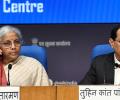
'Our attempt to honour the taxpayer has been since 2014 and more actively since 2019-2020 onwards.'

India is likely to grow by 7.5 per cent in the first quarter of the current financial year, driven by rising aggregate demand and non-food spending in the rural economy, according to an article in the RBI's May Bulletin released on Tuesday. The Indian economy has demonstrated marked resilience in the face of geopolitical headwinds impacting the supply chain, said an article on the state of the economy published in the May Bulletin.

Growing number of Internet and broadband connections can give the Indian economy the much-needed fillip by adding $ 17 billion to the gross domestic product (GDP) annually.

The RBI has changed the way it approached supervision in the past. Having seen a couple of collapses in the NBFC sector and the near-collapse of a few banks, it is focusing on regular drills to prevent a fire from breaking out, explains Tamal Bandyopadhyay.

But lower growth numbers in the quarters to come may not mean renewed weakness in the economy at the ground level, says Pranjul Bhandari.

"India's GDP growth rate is about 6.5 per cent this year and our forecast is that the GDP would grow by 8 per cent in FY 11," HSBC India's CEO, Stuart Arthur Davis, told reporters in Mumbai on Monday.

A combination of reduced cash intensity, a focused strategy of tax administration and GST is the way to go, say Sakshi Gupta, Tanvi Garg and Abheek Barua.
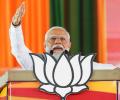
The BJP-led National Democratic Alliance's (NDA) slim majority in Lok Sabha may delay more far-reaching economic and fiscal reforms that could impede progress on fiscal consolidation, Moody's Ratings said on Wednesday. NDA securing a majority in the general elections will give a historic third term for Narendra Modi as Prime Minister of India. "We expect policy continuity, especially with regards to budgetary emphasis on infrastructure spending and boosting domestic manufacturing, to support robust economic growth.

India is likely to see above-normal rainfall in the four-month monsoon season (June to September) with cumulative rainfall rainfall estimated at 106 percent of the long-period average (87 cm), he said.

With the rapid evolution of channels like quick-commerce and the emergence of ONDC, the Indian retail industry is 'cautiously optimistic' for 2025, in which new-age technologies such as AI and automation will play a crucial role, driving efficiency and personalisation.

The government's initiative to migrate SEZ data from NSDL software to ICEGATE system for streamlined reporting of import data caused double counting of gold imports, resulting in inflated figures and the issue has now been largely rectified, government sources said. The downward revision has provided the actual picture of trade deficit (difference between imports and exports), which was earlier looking very high. The deficit for November will now be revised downwards from $37.84 billion to about $32.8 billion. Similarly, there will be a revision in overall import numbers as well.

In previews of Q2FY25 and beyond, industry analysts are expecting a turnaround for IT services. High teens earnings per share or EPS growth is expected for the next two-three financial years. The hopes are backed by deal wins of above $100 billion as at Q1FY25, up 16.6 per cent year-on-year ( Y-o-Y).

'The RBI's MPC will maintain the current policy rates (6.50%) at the policy meeting, given ongoing inflationary pressures.'

The government is proposing to use Artificial Intelligence and other innovative methods to check traffic violations and ensure that penalties are levied accurately, Union minister Nitin Gadkari said on Thursday. Addressing the 12th edition of the Traffic InfraTech Expo, the minister outlined plans for upgrading toll collection methods, including the exploration of satellite toll systems, which would improve efficiency and ensure transparency in toll collection. Gadkari noted that road safety cannot be achieved without integrating advanced engineering solutions, enforcement of laws, and the adoption of cutting-edge technologies like Artificial Intelligence (AI).

'I am optimistic about the Budget because of the fiscal discipline the government has committed to.'

The central government's fiscal deficit during 2023-24 at 5.6 per cent of the GDP was better than previous estimates of 5.8 per cent on account of higher revenue realisation and lower expenditure, according to official data released on Friday. In actual terms, the fiscal deficit -- or gap between expenditure and revenue -- was Rs 16.53 lakh crore, or 5.63 per cent of the GDP, which grew 8.2 per cent in 2023-24.

Government unveiled the much-awaited FTP for 2015-20 on April 1, 2015.

Novice investors must understand that volatility is an inherent part of equity markets and learn to navigate through such phases.

The slowdown is especially pronounced in rural areas, which have suffered two consecutive dry years.
The Reserve Bank of India (RBI) is expected to cut interest rates for the first time in nearly five years in Governor Sanjay Malhotra's first monetary policy committee (MPC) meeting on Wednesday. The meeting of the six-member MPC, which will culminate on Friday, aims to boost sluggish economic growth, which is seen falling to a four-year low. Malhotra took charge as the 26th RBI governor in December last year.

'We see mid-and small-caps as a real pot of gold.' 'From a 10-15 years perspective, mid-and small-cap are likely to outperform the larger index, as they have done in the past.'

'It does not understand economics. The entire focus of this government is skewed.'

With hilsa prices soaring, when you do cook it you need the finest recipe.
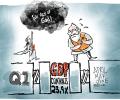
Dominic Xavier wonders whether the steep decline in GDP numbers should be considered as an act of God too.

'Consider 40% to 50% in equities, 10% in gold as a hedge, and the remaining 30% to 40% split between multi-asset funds and hybrid funds.'

Despite the rally in equities over the last few years, India, according to Christopher Wood, global head of equity strategy at Jefferies, is still in early stages of an equity cult. Any changes to the capital gains tax for equities - both long-term and short-term - in Budget 2024 scheduled to be announced on July 23, he believes, can trigger a bigger correction that what the markets witnessed post the Lok Sabha election outcome on June 4 that saw the Bharatiya Janata Party (BJP) lose majority, though it was able to form the government with the help of coalition partners.
India's economy grew by 1.6 per cent in the fourth quarter of 2020-21, restricting the full-year contraction to 7.3 per cent, official data showed on Monday. The fourth quarter growth was better than the 0.5 per cent expansion in the previous October-December quarter of 2020-21. The gross domestic product (GDP) had expanded by 3 per cent in the corresponding January-March period of 2019-20, according to data released by the National Statistical Office (NSO).

With decline in number of fresh COVID-19 cases and easing of restrictions, the country's gross domestic product (GDP) will grow at 8.5 per cent in FY2021-22, according to credit rating agency Icra Ratings. It expects the gross value added (GVA) at basic prices (at constant 2011-12 prices) to grow at 7.3 per cent in FY2022. "The impact of the second wave of COVID-19 and the ensuing state-wise restrictions was seen across a variety of high frequency indicators in April-May 2021.

Moody's Ratings on Tuesday said India's growing water shortage can disrupt farm and industry sectors and is detrimental to the credit health of the sovereign as rising food inflation and decline in income may spark social unrest. It said decreases in water supply can disrupt agricultural production and industrial operations, resulting in inflation in food prices and hence can be detrimental to credit health of sectors that heavily consume water, such as coal power generators and steel-makers.
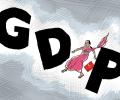
India's Gross Domestic Product (GDP) is expected to expand by 9.2 per cent in the current financial year, according to the Economic Survey 2021-22 tabled in the parliament on Monday. "Advance estimates suggest that the Indian economy is expected to witness real GDP expansion of 9.2 per cent in 2021-22 after contracting in 2020-21. "This implies that overall economic activity has recovered past the pre-pandemic levels," Economic Survey noted. Almost all indicators show that the economic impact of the "second wave" in Q1 was much smaller than that experienced during the full lockdown phase in 2020-21 even though the health impact was more severe, it said.

In a paper, EAC-PM accused Subramanian of "cherry-picking high-frequency indicators" to express his skepticism about the growth rates after 2011-12.

'Three manufacturing sectors can create jobs by the million: Apparel, food, and electronic assembly.' 'Let's talk to them and ask them what it would take to scale by a factor of ten,' suggests Naushad Forbes.

Gold price outlook 2025: Gold prices that have climbed over 30 per cent so far in 2024 to Rs 7,300 per gram in the Indian markets (up 28 per cent in dollar terms till November-end), are set for their best calendar year performance in 10 years, suggests a recent report by World Gold Council (WGC). However, this stellar run, analysts believe, may not carry through till the end of 2025 in the backdrop of economic and geopolitical headwinds.

After a robust 2023, foreign investors significantly scaled back their investments in Indian equities in 2024, with net inflows amounting to over Rs 5,000 crore, as elevated domestic valuations, coupled with geopolitical uncertainties prompted investors to adopt a more cautious stance. Looking ahead to 2025, FPI flows into Indian equities could see a recovery, supported by a cyclical upswing in corporate earnings, particularly in domestic-oriented sectors like capital goods, manufacturing, and infrastructure, Vinit Bolinjkar, head of research, Ventura Securities, said.
